Women in Data Science Cambridge turns 10
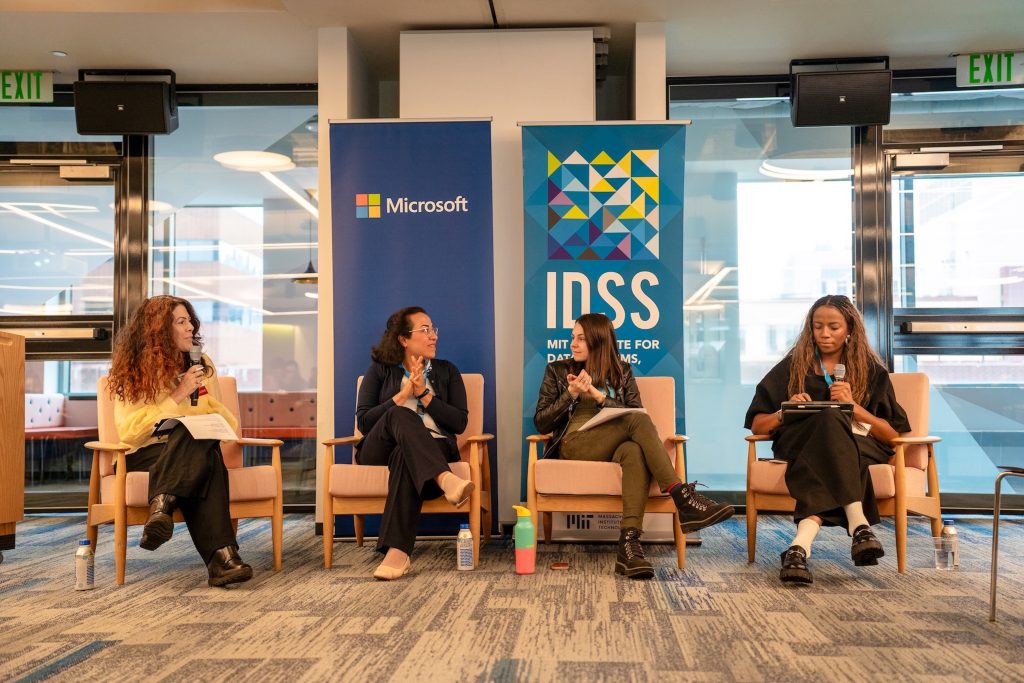
TPP Director Christine Ortiz (left) moderated a panel on Democratic Processes and Public Policy for WiDS Cambridge 2026, featuring (from l-r) Mona Birjandi, Principal Economist and Director of Data Analytics at Outten & Golden; Bailey Flanigan, Assistant Professor of Political Science and Computer Science at MIT; and Lindsey Batteast, Senior Strategist in Responsible AI at Google. Photo credit: Robin Xiong
The annual WiDS Cambridge conference, co-hosted by IDSS and Microsoft, marked 10 years with a day of connections and opportunities, plus talks about human-agent collaboration, data and democratic processes, extreme weather, and more.
In March, IDSS co-hosted the tenth annual Women in Data Science Cambridge conference with Microsoft Research at the Microsoft NERD Center. WiDS Cambridge is a regional part of WiDS WorldWide, which was launched at Stanford University in 2015 to highlight outstanding women working in the data science field. WiDS Cambridge 2026 featured a keynote and two panel talks, a round of lightning talks, poster presentations, and many opportunities for networking, upskilling, and career exploration.
“We are thrilled to have been championing WiDS for ten years at IDSS,” said IDSS director Fotini Christia, the Ford International Professor of Social Sciences in the Political Science department. “WiDS plays such an essential role, through this conference and additional programming throughout the year, in connecting practitioners to new tools, methods, connections, and opportunities. It’s a great community where all are welcome and women are truly lifted up.”
The 2026 keynote at WiDS Cambridge, titled “Beyond the Hype: Designing Human-Agent Collaboration for Decisions That Matter,” was delivered by Casium Founder and CEO Priyanka Kulkarni. Kulkarni said the topic of human and AI agent collaboration keeps her up at night. “AI is getting better at sounding confident,” said Kulkarni. “But in the real world, the decisions that matter most are messy, incomplete, and high stakes. They affect people’s lives and livelihoods. So, the question isn’t ‘can an agent do it?’ It’s ‘how do we design human-agent collaboration, so the outcome is actually trustworthy?’”
Kulkarni ultimately highlighted the foundational differences between designing agents and building software. “Software automates tasks. What we are doing is redesigning how decisions get made, who has the agency, what information shapes the outcome, and where accountability lives,” said Kulkarni.
The morning panel, “Democratic Processes and Public Policy,” was moderated by MIT Technology and Policy Program (TPP) director Christine Ortiz, and explored the role of data in 21st century democratic decision making. Panelists discussed ideas for getting public input on policy and even collective decision-making bodies like citizen assemblies, along with the complex data problem of forming groups that can be sufficiently arbitrary while remaining sufficiently representative. One open question for the future that emerged: what can policy makers learn from AI agents modeling ‘synthetic societies’?
“A perspective that really resonated,” said WiDS Cambridge Co-Ambassador Stephy Romichan, “is that it’s easy to focus on building and optimizing models, but it’s equally important to step back and consider how those systems affect the people interacting with them.”
For the afternoon panel, “Extreme Weather and Pollution: Impact and Equity,” IDSS doctoral student Abigail Bowering moderated a group to discuss strategies for improving extreme weather prediction, monitoring and mitigating air pollution, and modeling the interaction of huge, complex planetary systems like ocean currents and weather. Panelists emphasized challenges from identifying and prioritizing contamination areas, inequality and advocating for financial investment, and democratizing data generation so that communities can be involved in outcomes that affect them.
“One moment that really resonated with me during the second panel: panelist Desirée Plata said ‘Lack of education does not mean lack of knowledge,’” wrote WiDS Cambridge attendee Emma Virnelli. “One of the reasons I originally started doing work in data was my flood resiliency work as an undergraduate research assistant. Interviewing those impacted by flooding and hearing their stories gave me knowledge I could not get in a classroom.”
With mentoring hours, lightning talks, poster presentations, and an area for local companies and programs to share opportunities, WiDS Cambridge 2026 was a full day 10 years in the making. Later this month (April 18), WiDS Cambridge will also host a Datathon Workshop, which features a data science/machine learning tutorial followed by a team-based practical session focused on a single data science task: “Predicting Wildfire Impact: From Infrastructure to Equity.”
“What has made organizing the WiDS Cambridge Datathon Workshop so meaningful to me over the past two years is seeing people from very different backgrounds come together to learn, collaborate, and grow together,” said MIT graduate student Sharut Gupta. “One of the most rewarding parts has been seeing even the quietest people in the room find their voice by the end of the day, asking questions, sharing ideas, and actively engaging. Helping create that kind of space has meant a lot to me, and I’m very excited to do it again this year.”

